The gap leaders face behind the scenes
In coaching conversations, a familiar pattern shows up again and again.
Leaders talk about:
- navigating competing agendas
- influencing without formal authority
- managing stakeholders with unspoken power
- reading the room and sometimes misreading it
- doing the “right thing” and still getting resistance
- feeling exposed, scrutinised, or second-guessed
These aren’t technical problems.
They aren’t emotional blind spots.
They’re political realities and most leaders were never taught how to work with them openly or safely.
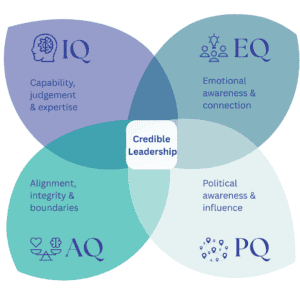
Credible leadership sits at the intersection of four distinct but interconnected capacities.
In my work, I explore how credibility is built and quietly eroded through the balance (or imbalance) of IQ, EQ, PQ, and AQ. Each capacity matters on its own, but none of them was designed to operate in isolation.
IQ – Intelligence Quotient
Your expertise, judgement, and decision-making capability.
This is what gets you promoted and trusted to make calls when stakes are high.
→ Explore IQ in practice
EQ – Emotional Quotient
Your ability to listen, relate, and respond well to others.
This is what builds trust, connection, and psychological safety when it’s supported by clarity and authority.
→ Read: When Empathy Becomes Over-Responsibility
PQ – Political Quotient
Your ability to read the system, understand power and influence, and navigate organisational dynamics with integrity.
This is what sustains leadership in complex environments where decisions aren’t made in neat lines.
→ Explore the politics leaders are really navigating
AQ – Alignment Quotient
Your ability to stay aligned with your values, integrity, and boundaries while carrying responsibility.
This is what sustains leaders over time without hardening, burning out, or losing themselves in the role.
→ Explore alignment behind the scenes
When IQ, EQ, PQ, and AQ are in balance, leadership feels grounded, credible, and sustainable.
When one is missing, leadership becomes far harder and heavier than it needs to be.
Where leadership strain really comes from
Leadership strain doesn’t come from incompetence.
It comes from imbalance and from staying misaligned for too long.
- High IQ without EQ → technically right, relationally disconnected
- High EQ without PQ → caring deeply, but lacking influence
- High IQ and EQ without PQ → capable leaders who still get stuck, side lined, or burnt out
- High IQ, EQ, and PQ without AQ → influential and capable on the surface, but internally conflicted, over-extended, or slowly eroding their own boundaries.
Behind the scenes, many leaders aren’t just over-functioning they’re doing it at the expense of their own alignment.
They know what matters.
They can feel when something is off.
But without permission, language, or support to act on it, they stay misaligned, carrying responsibility that isn’t theirs, absorbing tension to keep things moving, and slowly disconnecting from themselves in the process.
Why this matters (especially for women)
Many leaders I work with are highly capable and deeply relational. They’re conscientious, values-led, and committed to doing the right thing.
They often carry a strong sense of responsibility for people, outcomes, and culture while navigating organisational politics without clear language, permission, or support.
- This isn’t about playing games or compromising integrity.
- Political intelligence isn’t manipulation.
It’s understanding how influence actually works so you don’t keep paying for it with your energy, confidence, or credibility.
- For many women leaders in particular, the cost of misalignment is cumulative.
- Saying yes when something doesn’t sit right.
- Carrying responsibility that isn’t theirs to hold.
- Absorbing tension to keep systems functioning.
AQ isn’t about opting out or pulling back. It’s about staying anchored while still influencing.
The work that happens quietly
This is the work of alignment.
Credible leadership is rarely loud.
It’s the quiet work of:
- deciding what’s yours to carry and what isn’t
- choosing when to speak, and how
- holding your ground without hardening
- influencing without over-explaining
- staying aligned with yourself in complex systems
- knowing when something no longer aligns and responding without self-betrayal
This is the work that happens behind closed doors – long before outcomes show up on paper.
And it’s the work that keeps leadership credible, human, and sustainable, especially in complex systems.
In the articles that follow, I’ll explore each of these capacities – IQ, EQ, PQ, and AQ through real leadership moments that rarely make it onto agendas.